
Compassion Fatigue….is rife in the helping professions!
Why?
Because most of those who step into these professions do so because of their own previous experiences.
Experiences of always being the one in their family who ‘had the answers’. ‘Took care of everyone else. ’ Felt responsible for the feelings and needs of others at an age that no child should feel responsible for that.
Experiences of not having their own needs met for being ‘listened to’, ‘heard’, ‘respected’. Of wanting to now make damn sure that no-one else needs to feel the same and they will do all they can to help prevent that!
The thing is, these children gravitate towards these roles within their childhood, and then into adulthood, because they are natural caregivers. It was always, let’s say, part of their DNA.
BUT
All people need to work on their old wounds and patterning to prevent unhealthy habits from stopping them from living their most fulfilling life and managing their own mental health.
Of course, I am biased, but I believe everyone should have therapy! Because we all have ‘stuff’ to deal with, unhelpful patterns and beliefs to overcome. Therapists, I would say, are amongst those who need support the most, but because of their natural tendency to care for others, what we usually notice is that they neglect caring for themselves. Reliving those same patterns from childhood. No longer not having their needs met by others, but now not meeting their own needs as adults. Because they have no idea how.
This is why Compassion Fatigue is rife in the caring professions! Why it is paramount that helping professions take personal responsibility for working on their own past wounds, and overcoming patterning that no longer serves them.
ALSO
It is the responsibility of those services that they work for to create a system that allows them to care for themselves. This cannot just be another job for the carer.
I make no secret that one of the reasons I left the biggest ‘caring’ system of them all was because the system I was part of at the time did not allow me to effectively balance my values of motherhood, career, and managing my own wellbeing. I had to step into running my own business…possibly one of the most stressful things anyone could decide to embark on, to find that balance. How ironic is that it was stepping into more stress that allowed me to do that? Because I felt empowered to make choices that were right for me. Because I created the system needed for ME to thrive in all aspects of my life.
I have been determined to do the same, create the same, for all of team Laura Greenwood Therapy. To allow them to thrive as a human being, own their individuality as a therapist, whilst taking care of their families, and looking after their wellbeing. To show, there is another way.
I believe self-care isn’t just a buzzword; it’s an ethical necessity. Supporting our own mental health is how we stay psychologically effective, compassionate, and connected to the work we love.
For Maternal Mental Health Awareness Week 2026, I reached out to the team to ask them how they care for the emotional demands of their roles and what helps them stay grounded. I also asked them if they felt safe to share any times when they themselves felt ‘victim’ to the compassion fatigue experienced by other caring professionals.
I hope that in their reflections and stories, you find validation. You find guidance. You find hope. Whatever you need to take from our words. We write them for you.

“To prevent compassion fatigue as a therapist, I’m mindful of how I structure my time and energy. I give myself enough space between clients to reset, avoid overloading my schedule, and plan my workload around both my family commitments and energy levels. I prioritise self-care in ways that are sustainable, incorporating exercise and regular micro moments throughout the day — like deep breathing, short walks, grounding exercises, and staying hydrated. These small but intentional acts have a cumulative effect, helping me stay regulated, present, and able to support others without burning out.”
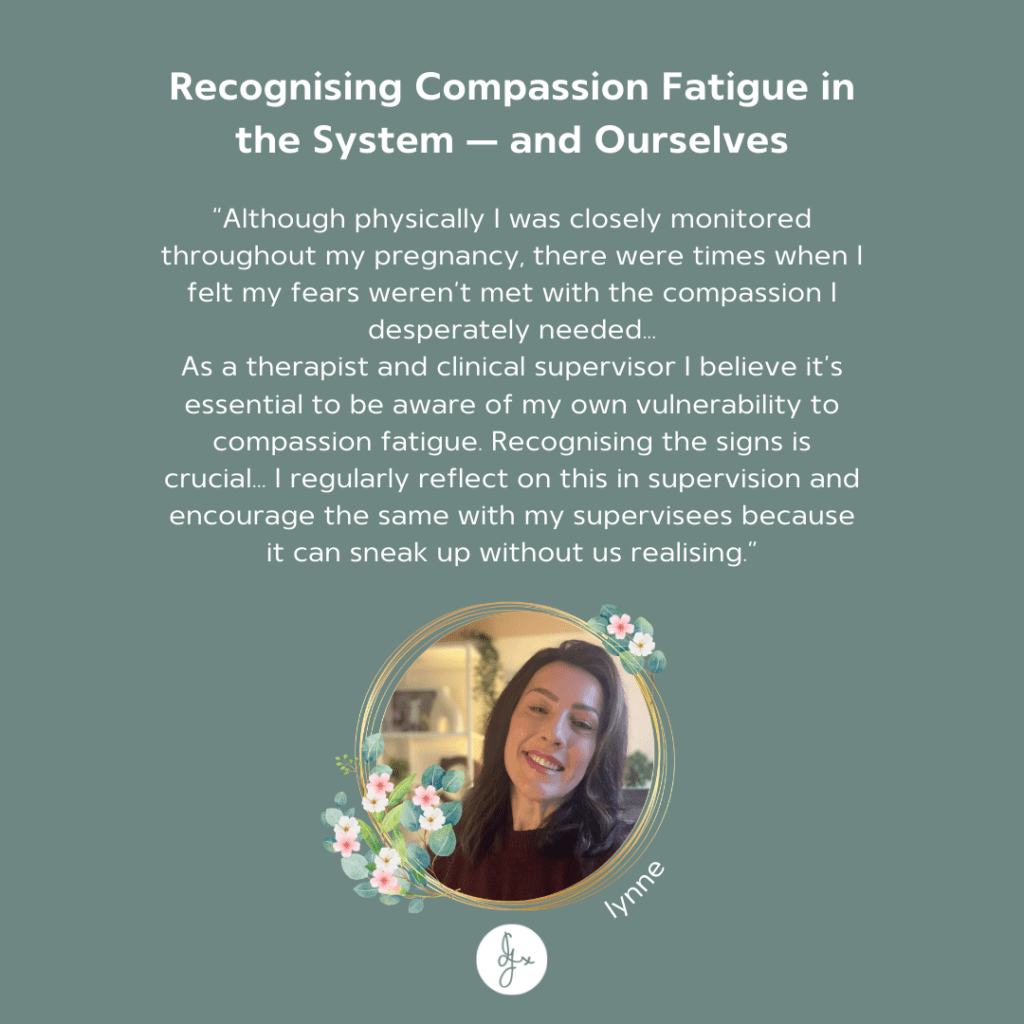
“Given that my first daughter was born prematurely at just 30 weeks due to an emergency placental abruption, anxiety was a constant companion during my second pregnancy.
I was terrified of going through that experience again and the risks it posed to me, my unborn baby, and my family, especially since my underlying health condition added to those risks.
Although physically I was closely monitored throughout my pregnancy, there were times when I felt my fears weren’t met with the compassion I desperately needed. Instead, I often sensed a feeling of blame. One consultant even bluntly asked me why I would risk having another pregnancy, which felt incredibly shaming as an expectant mother and ruminated on excessively. It was a tough time, and the lack of understanding from some in the medical community only added to my emotional struggles.
Looking back, I realise that this response may have been driven by compassion fatigue, but it had a huge impact on me at the time. I found myself caught in negative thoughts like, “What have I done?” and “I should just be grateful for what I have,” leading to feelings of guilt and shame. Ironically, this added stress likely made things worse, increasing my own risks.
In hindsight, I don’t blame these individuals because I understand that compassion fatigue can stem from the emotional demands, stress, and lack of support that professionals face, especially in public sector roles.
However, as a therapist and clinical supervisor, I believe it’s essential to be aware of my working environment and my own vulnerability to compassion fatigue. Recognising the signs is crucial for maintaining my own well-being and effectiveness in helping others, as well as for the well-being of my clients.
I regularly reflect on this in supervision and encourage the same with my supervisees because it can sneak up without us realising.”
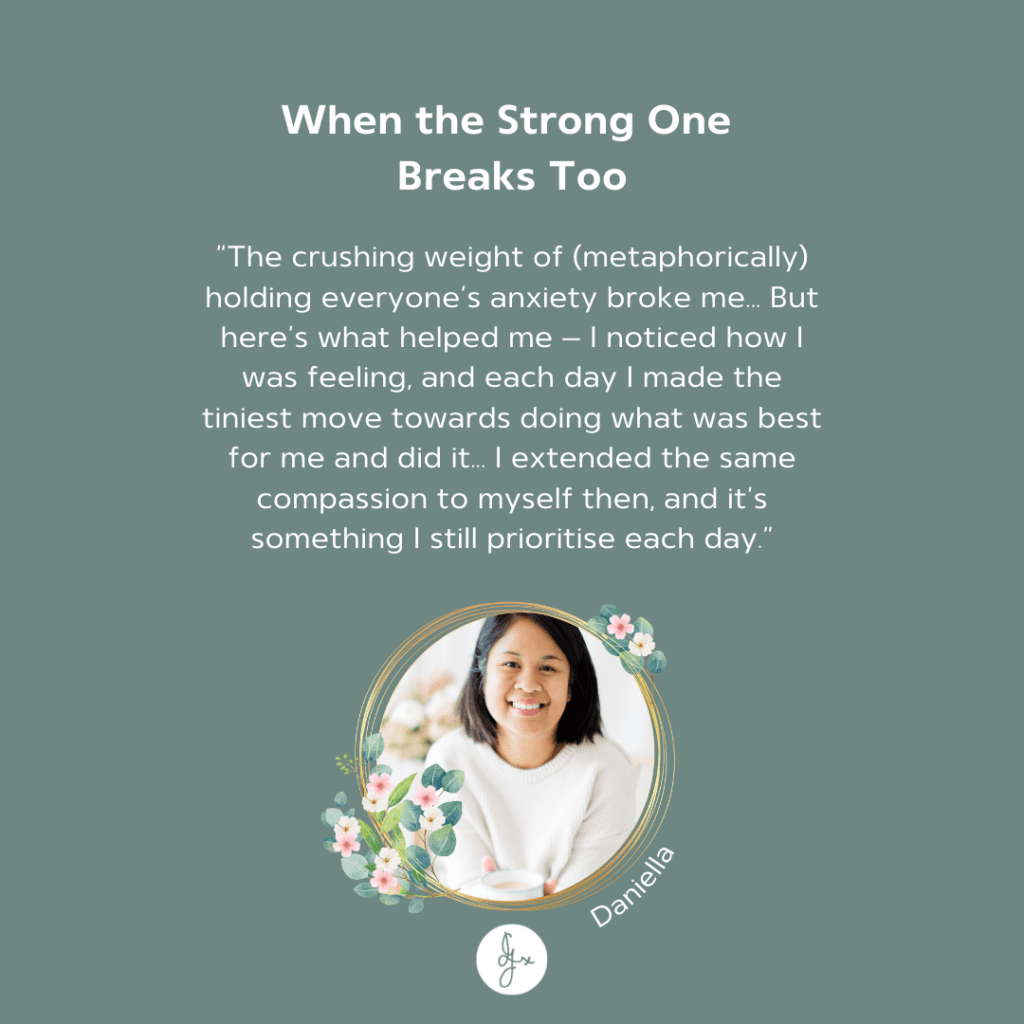
“I’ve always viewed myself as resilient, strong, and capable of navigating some pretty tough experiences. And then the pandemic happened.
I was working part-time in the NHS as a Senior CBT Therapist and part-time at Goldsmiths College, University of London as a Lecturer and Clinical Supervisor; AND I was mum to two children under the age of 5.
Like a tsunami wave we could see but we could not outrun, the panic was palpable everywhere I turned and was ever present in every conversation I had.
As a senior therapist managing other therapists, it was tough. As a lecturer training CBT therapists through a pandemic, it was tough. As a psychotherapist working with clients whose difficulties were exacerbated by the global anxiety, it was tough. As a mum who didn’t learn to read or write phonetically, it was tough.
The crushing weight of (metaphorically) holding everyone’s anxiety broke me. I felt helpless against the current of uncertainty. But here’s what helped me – I noticed how I was feeling, and each day I made the tiniest move towards doing what was best for me and did it.
I stopped watching the nightly reports, I rested when I needed to, I made space to cry when I needed to, I remembered to breathe, and I practiced self-care. Most importantly, I let go of expectations (all the shoulds that my mind sometimes tells me) and focused on what mattered most in that moment.
I extended the same compassion to myself then, and it’s something I still prioritise each day.”
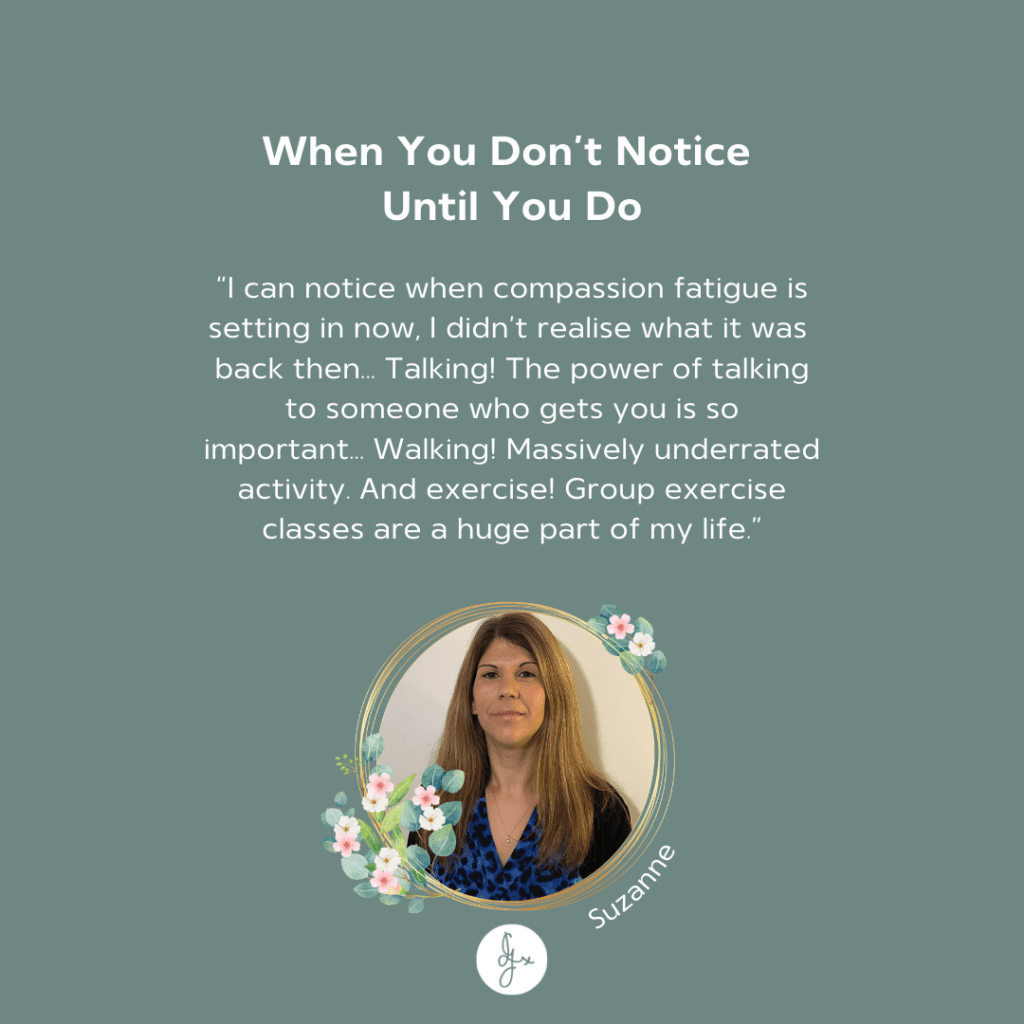
“As a therapist and a mother, I have experienced compassion fatigue. The first noticeable time was a few months after I returned to work after having my second child.
I found juggling my role as a mum and therapist a tricky balance. We were just coming out of the pandemic, meaning I’d had little to no social contact throughout maternity leave, and I had little to no self-care within my routine.
I can notice when compassion fatigue is setting in now. I didn’t realise what it was back then. The signs for me are a loss of patience, an increase in frustration with myself, and my emotional resilience isn’t as strong.
My ways to manage this: Talking! The power of talking to someone who gets you is so important, even if it’s a little chat on WhatsApp. Walking! Massively underrated activity. always feel calmer after some fresh air. And exercise! Group exercise classes are a huge part of my life, I notice if I have a break from classes, my wellbeing suffers. If I’m not taking steps to look after my own self-care, then I’m more likely to struggle with compassion fatigue.”

“As a therapist being married to another therapist, I find that almost every day the pair of us get the opportunity to offload, decompress, and process our working day with one another, and it does us both the world of good.
Whether this is the chance to contemplate our clinical decisions, or reflect on how it has personally affected us or our outlook on things. It can be a really tough job at times, and I’m glad that I can share this with someone in the know, a non-judgmental counterpart, someone who gets it.
Another facet to this is that we encourage each other to go on and thrive. If I ever have doubts, I know that my wife would support me through those and spur me to achieve my career goals — for example, working with complex trauma and children and adolescents.
I know that I have done the same for her with her ambitions to work with more perinatal cases, which has been especially difficult considering how much input was needed to get pregnant in the first place and the subsequent miscarriages that followed.
We help each other through our own stuff for our own sake, and in turn, this leads to the betterment of other people. It leads us to empathise more than ever with what people go through and reminds us how important it is to help people in their time of need.
Having someone to reflect on this with is invaluable; therapist, wife, or significant other — I think it improves who I am.”
“I notice compassion fatigue in the quieter moments, at the end of a day when a client’s story lingers, when empathy feels heavier and my usual curiosity starts to dip. It doesn’t arrive suddenly, but builds over time, showing up in subtle ways: a tightness in my body, quicker breathing, a sense of depletion, or the quiet worry that I have less to give than I’d like. I’ve learned not to ignore these signals, but to see them as an invitation to turn towards my own wellbeing rather than push through.
Caring for myself has become essential, not optional. Movement helps me process what I’ve been holding, whether that’s a walk to ground myself or time at the gym to release tension. Being outdoors offers a different kind of regulation, a reminder that I don’t have to carry everything. At home, connection restores me; time with my partner and children allows me to step out of my professional role and simply be myself, receiving as much as I give. Alongside this, learning to set boundaries and say no has been one of the most important shifts. What once felt like guilt now feels like sustainability, protecting the presence my clients truly need.
On a deeper level, this work inevitably shapes me. Bearing witness to pain and trauma challenges my sense of safety and perspective, and requires space for reflection, supervision, and honesty about my own experience. Compassion fatigue isn’t something to eliminate, but something to understand and respond to with care. By staying aware and intentional, I’m able to protect space within myself, not only sustaining my work, but deepening it.”
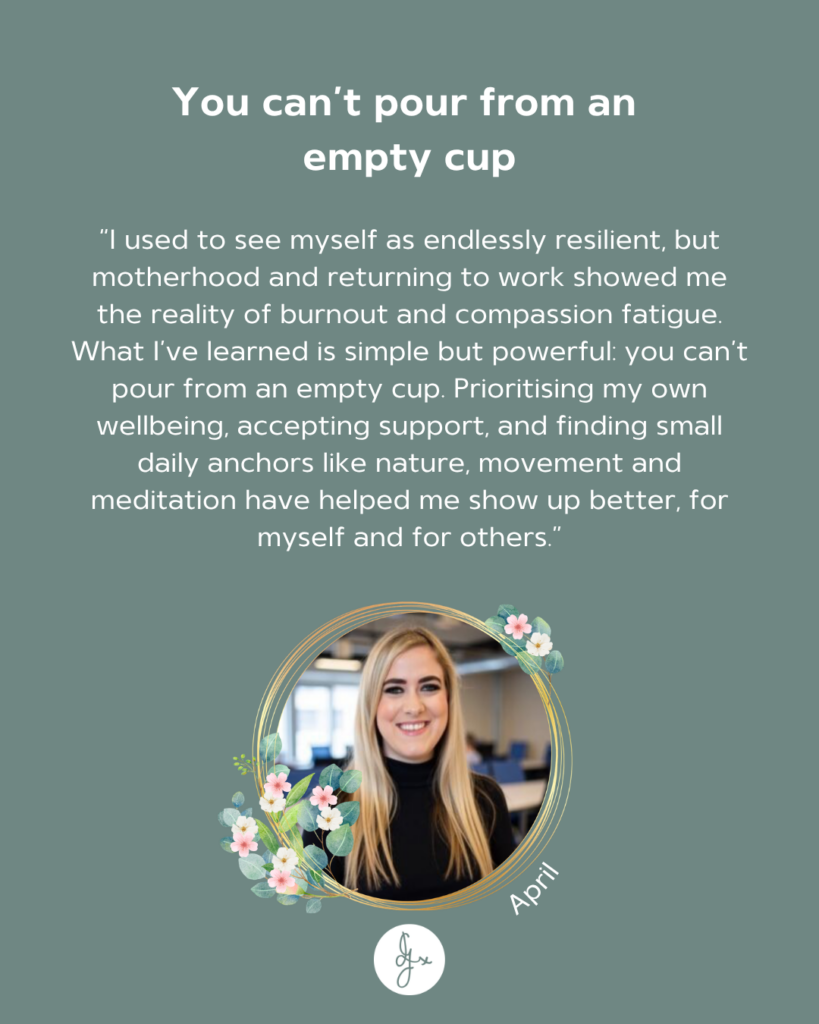
“Before becoming a mother, I saw myself as mentally resilient—someone who could give endlessly to others without it costing me. But returning to work after maternity leave challenged that belief more than I expected. The emotional load felt heavier, the pace relentless, and I found myself experiencing burnout and what I now recognise as compassion fatigue. If you’ve ever felt drained, overwhelmed, or like you have nothing left to give, you’re not alone.
What I’ve come to understand is that we can’t support others effectively if we’re running on empty. Caring for myself isn’t selfish, it’s essential. That’s meant making intentional changes: prioritising genuine time for myself, allowing others to support and hold space for me, and reconnecting with who I am outside of my roles. Simple practices like being in nature, movement, meditation and music have become anchors that help me return to myself when things feel overwhelming.
I don’t have it perfectly balanced, but I’m more aware now. I recognise the signs sooner, respond with more self-compassion, and make a conscious effort to practice what I share with others. And that shift, towards caring for myself as much as I care for others, has made all the difference, not just for me, but in the energy I bring to those around me.”
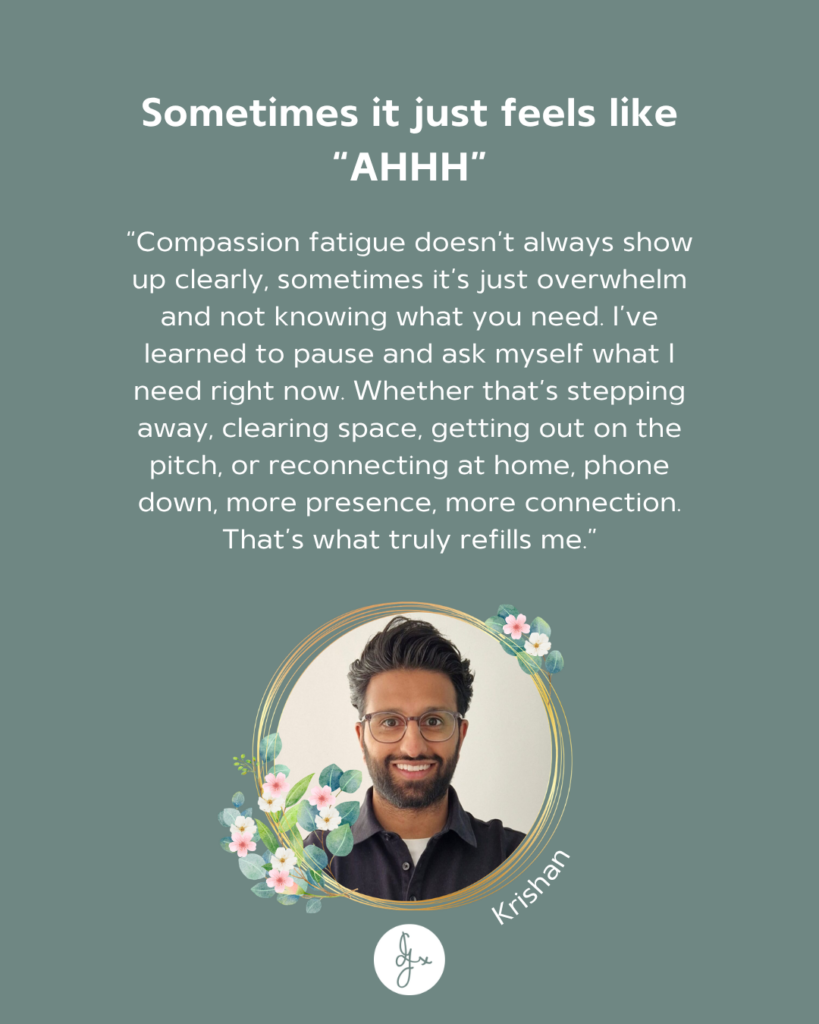
“If I’m being honest, compassion fatigue for me doesn’t always arrive with a neat label attached. Sometimes it just feels like a big ‘AHHH’ — an overwhelming sense of not quite knowing where to start or what I even need in that moment. And I think that’s something a lot of therapists don’t talk about enough.
What I’ve learned is that when I hit that wall, the most important thing I can do is pause and work out what I actually need right now — not tomorrow, not in an ideal world, but in that moment. Sometimes that’s coming off my phone and stepping away from the noise. Sometimes it’s looking at my diary and being honest with myself about what can wait — cancelling or postponing the things that aren’t urgent and giving myself permission to do that without guilt.
And then there’s football. Getting out on the pitch is my safe place. It clears my head in a way that nothing else quite does — there’s no room to ruminate when you’re chasing a ball around!
But probably the most grounding thing for me is connection. When I notice I’m feeling disconnected or running on empty, I make a conscious effort to come home and really be there. Phone down. Extra silly with the kids. More cuddles all round. It sounds simple, and it is — but that warmth from my wife and children reminds me of what matters and genuinely refills me in a way that no amount of self-care advice ever could.”
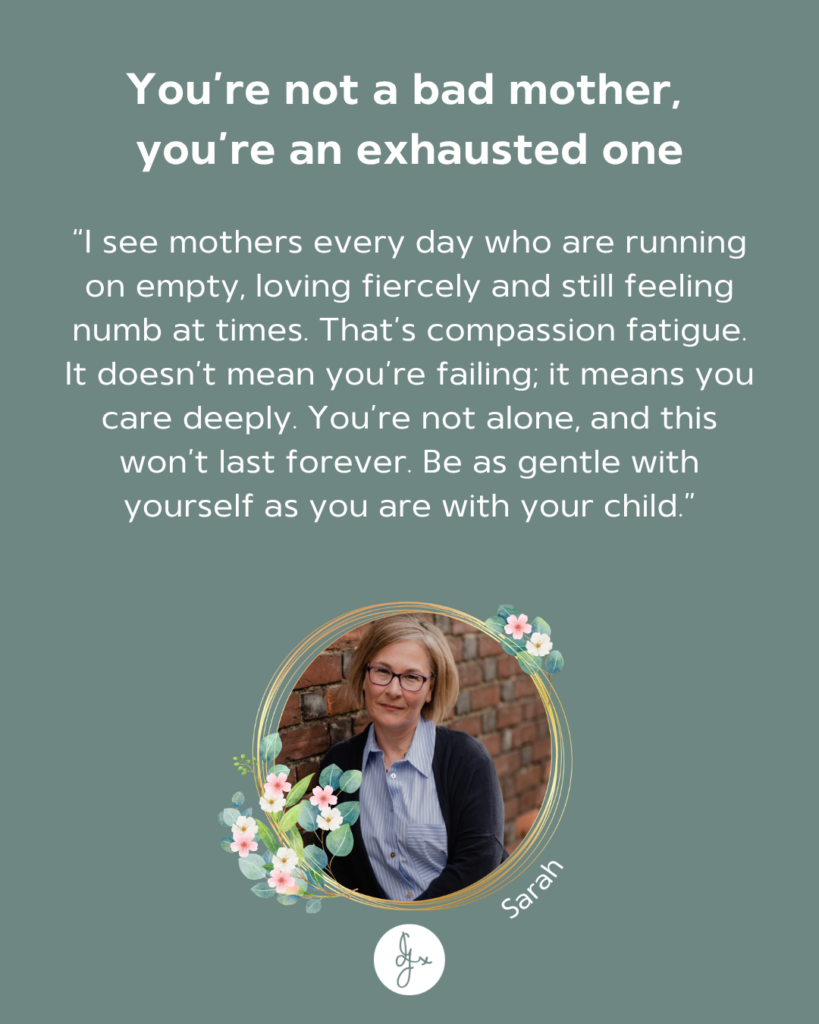
“I work with mothers every day who are running on empty. Who love their children fiercely and completely, and who are also exhausted in a way that’s hard to put into words. I see you in the therapy room, and I recognise you…because I’ve been there too.
As the parent of a neurodivergent child, I know what it is to be in the middle of a meltdown and feel myself go numb. To know, with every part of my heart (and training), that my child is in distress and can’t help it. And yet still feel completely disconnected in that moment. Unable to reach them. Unable to reach myself. That’s compassion fatigue. And it doesn’t mean you’re a bad mother. It means you’re a human one.
If you’re reading this and something feels familiar…the exhaustion, the numbness, the feeling that you have nothing left to give…I want you to know that you are not alone. What you’re feeling is a sign of how much you care, and how much of yourself you are giving – every.single.day…every.single.moment!
This won’t last forever. Things will change. And until they do, please be as gentle with yourself as you would be with your child.”
A Collective Message from Laura Greenwood Therapy to You
Compassion fatigue doesn’t mean we’re weak. It means we’re human. And recognising its presence is not a sign of failure — it’s a sign of deep awareness that something needs to change.
Whether you’re a therapist, healthcare worker, teacher, parent, or anyone in a caring role, please know you’re not alone in this. Take the break. Drink the water. Go for that walk. Cry if you need to. Reach out to someone who gets it.
You are not just the caretaker — you are also someone who deserves care.
Laura and the Team x