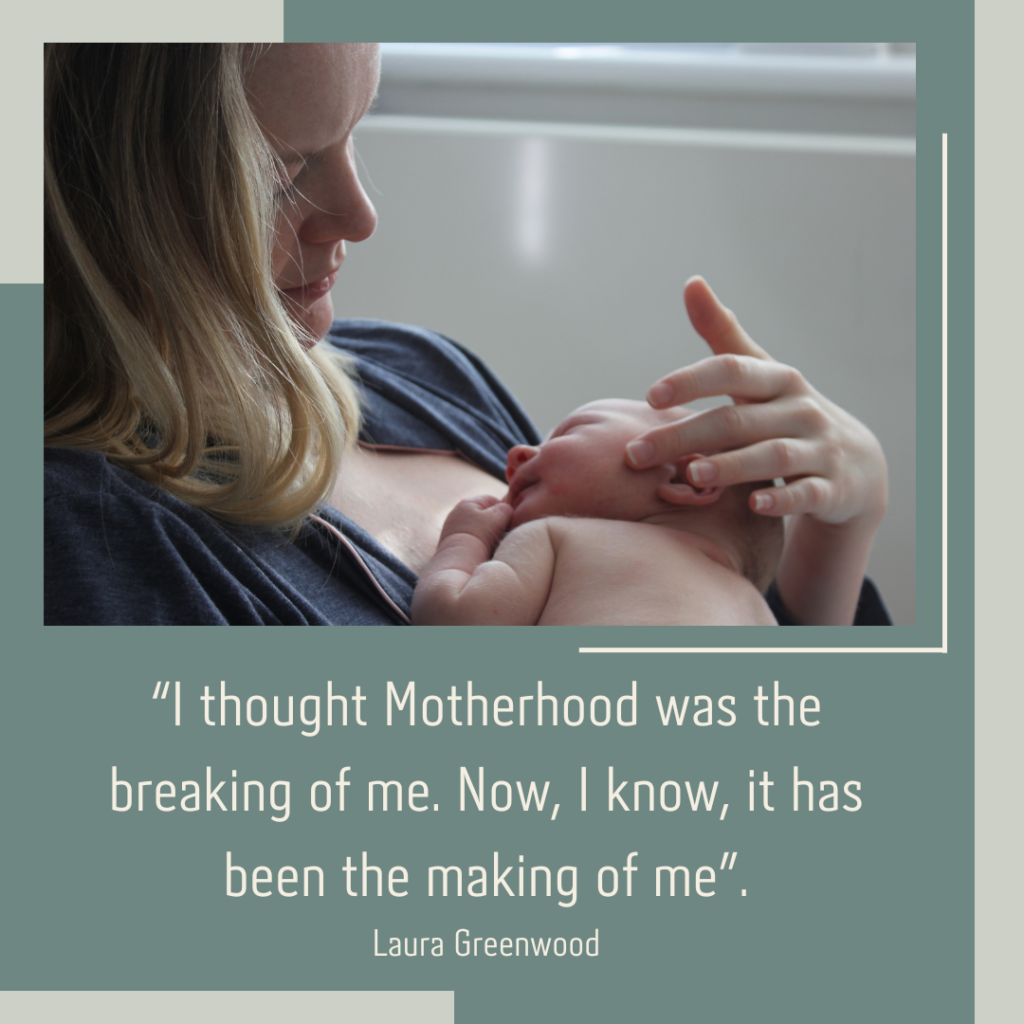

A personal blog and reflection from Sarah Cosway, Psychotherapist at Laura Greenwood Therapy, all about her own experiences of learning to parent a neurodivergent child. Edited by Laura Greenwood, Founder and fierce activist for sharing the untold stories of Motherhood.
Holding your perfect newborn for the first time, you feel that wave of love and desire to protect them forevermore. We all imagine the best for our children; the person they’ll become, and the possibilities waiting ahead.
When I held you, I imagined a world that would open easily before you. I didn’t yet know how different that world would look, or how it would make me feel.
When Expectation Does Not Meet Reality… We Grieve
Grief comes in many forms, and sometimes it is the loss of a hoped-for future. When we realise that the future we pictured for our child will be different, our brains can register it as a loss. We form attachment bonds not only to our child, but also to the life we imagined they would have. When that imagined future changes, grief is a natural response. Not because we love our child any less, but because the story we held for them has shifted.
I’m not sure when I first realised my firstborn was “different”; I think it was more of a slow realisation creeping up on me. The sensory sensitivities, the subtly different ways of playing compared to peers, and the sleep issues were all things that were easily explained away and dismissed as the neuroses of first-time parents. We hadn’t parented before, so we had no reference point to help us understand where “normal” ended and “unusual” began.
It was only when a childminder, who had parented a neurodivergent child herself, witnessed me trying to cope with one of the numerous daily meltdowns and commented that it was “extreme” that I finally felt validated in my concerns—after so long of being met with the stock response: “All toddlers have tantrums!”
But along with that validation came a mourning for the version of childhood I had imagined for him. My bright and charismatic child was increasingly misunderstood by the outside world and became less and less comfortable in his own skin. Once, I had imagined the wonderful opportunities that would lie ahead for him; now, all I could see were barriers and challenges.
How can I feel grief when my child is right here, exactly who he’s meant to be?
Many parents of neurodivergent children experience this same, silent grief. Not because their child is wrong, but because they recognise that the world is not yet built to fit them. This form of grief is called ambiguous grief; an ongoing adjustment rather than a reaction to a single event.
My grief wasn’t about the physical loss of my child, but the loss of my hopes for him: a parallel imagined life that would never come to pass. It was also grief for the loss of my own experience of parenting. Those imagined idyllic family days out, which, in reality, became marathons of endurance in managing emotional dysregulation.
Ambiguous grief arises when the person you love is physically present, yet there is still a sense of loss in some way. In this case, the imagined future. We can also experience ambiguous grief when passed over for promotion, through lost opportunities, or when illness or circumstance shifts what once felt possible. Because nothing tangible has been lost, this grief can feel invisible or even invalidated by others, leading to feelings of guilt, isolation, blame, and confusion. As a parent, it can be difficult to understand this form of grieving, and perhaps even harder to recognise it as grief at all.
A Silent Struggle
And there’s also grief for the parenting experience we thought we’d have, which never quite arrived. A friend once told me that parenting her child wasn’t as hard as she had feared it would be, and that it was more rewarding than she had dared to allow herself to hope. I felt so much shame, guilt, and grief at hearing that, because my experience was the polar opposite. So much harder and less rewarding than I ever imagined. The words that best captured that time for me were “relentless” and “endurance.” I stayed silent on the matter and quickly changed the subject. How could I ever admit what I was feeling in comparison? Of course, I spiralled internally, questioning what I must have done wrong. So powerful were those emotions that, fifteen years later, I still recall that conversation with clarity. Burned into permanence in my memories.
The Masked and Unmasked Child…Standing in the Eye of an Emotional Storm
As with any form of grief, ambiguous grief can resurface at unexpected times, catching us off guard—for me, it was when observing his peer group meeting certain milestones or making transitions smoothly, taking it all in their stride. For us, everything felt like a struggle… a struggle that went on behind closed doors and was difficult for others to understand. He was bright and quickly learned that masking got him through the school day. To the outside world, I had a personable and compliant child—one who would become non-compliant or spiral into meltdown the moment he was behind the safety of the front door.
The closest I could come to describing those meltdowns was through the film Looper, where a frightened child’s emotions quite literally tear the room apart. The child’s outbursts weren’t malicious—they were intense emotions turned outward, magnified by his telekinetic powers.
Sometimes, that’s how parenting a neurodivergent child felt, at least to me: standing in the eye of an emotional storm, knowing that they’re not choosing this but can’t do anything to stop or control it. Of course, outsiders thought I was exaggerating when I mentioned the film. They couldn’t appreciate the intensity of these moments, never having experienced them.
Over the years, I discovered what so many people misunderstand about meltdowns: they’re not deliberate acts of defiance or tantrums. They are the body’s way of surviving unbearable overwhelm. When the nervous system is completely flooded, all ability to reason disappears. No amount of logic or discipline can reach a child in that state. What is needed is calmness, safety, and compassion. But providing that scaffolding as a parent takes an enormous emotional toll, especially when it’s needed multiple times a day.
Spot the Difference
We’re wired to compare; it’s human nature.
Despite our best intentions not to, we can’t help ourselves. Our brains look for patterns and discrepancies. When we see other people’s children meeting milestones, it can trigger not only worry but also self-critical thoughts. We feel total responsibility for creating and nurturing this young life, and that can extend to feeling that our child’s difference is somehow our fault. Recognising this as a normal response of the mind—a cognitive bias—doesn’t stop it from hurting, but it can help loosen the grip it has on us.
Even as a teenager, it was all too easy for my son’s struggles to be dismissed by others: “No teenager likes getting out of bed, do they? That’s normal.” But how many teenagers experience hour-long meltdowns precipitated by simply getting up?
No one saw the hours I spent sitting in the car with him outside the school gates, absorbing his emotional dysregulation. All so he could cope with facing the expectations of his peers and teachers in the day ahead.
Finding His Own Way
And yet, he has found his own way.
Messy, chaotic, and not the way I could or would do things myself. But he’s made it to adulthood in one piece, and yes, there were times I seriously doubted he would, given his discomfort in his own skin. Now, however, he sings from his own song sheet, recognises his differences as a uniqueness to be embraced, and is surrounded by other beautifully unique—and “different”—souls in his social circle, where nobody is different because everybody is different.
Accepting The Child We Are Given, Not the One We Planned For
Part of my journey has been accepting how different his song sheet is from mine. He still spirals and melts down, often needing me to help him process, because he doesn’t trust anyone other than his parents to allow himself to unmask.
Acceptance is the key aspect here. In acknowledging and accepting my ambiguous grief, it has softened. I doubt it will ever fully leave me, as I know he will struggle in the future and will always face additional challenges… and of course, I desperately wish that weren’t so! But just as I try to parent with compassion, I am also learning to have a compassionate stance toward myself. It’s no one’s fault that things are the way they are, and with time, I have come to appreciate that difference isn’t lesser; it brings uniqueness into the world, which is definitely something to be celebrated.
There can be loss, but also richness. Both can be true at once.
Softening the Pain
In Compassion-Focused Therapy, we talk about softening pain by meeting it with understanding rather than judgment. It is important to understand that acceptance isn’t giving up; it’s recognising that fighting reality, and things that are out of our control, only adds a layer of suffering on top of the original pain. By giving up the struggle, we release our suffering, allowing ourselves the opportunity to process our pain.
We grieve because we love. We’re not broken for feeling this way. We are human, and love, in all its complexity, is still love.
Love is love.